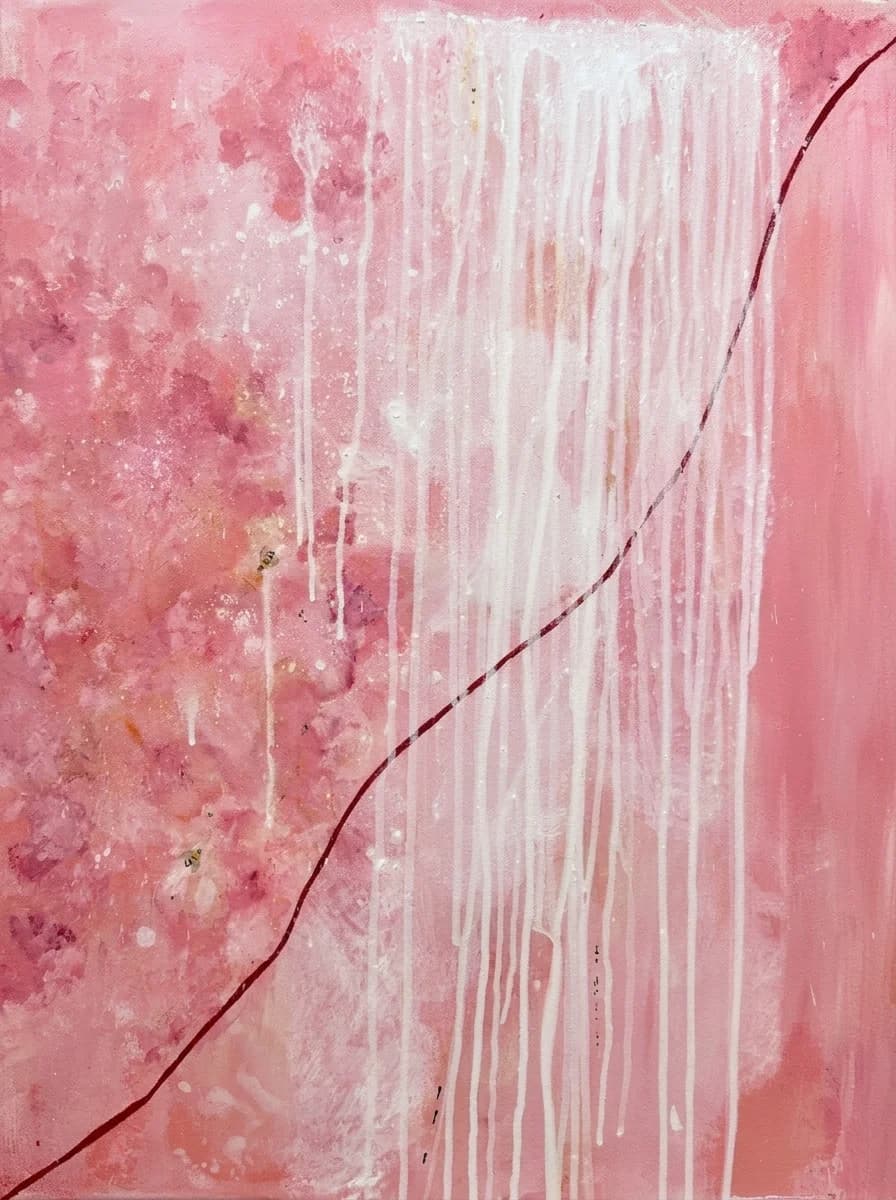


"The hurts of peace are preferable to the agonies of war"
"The hurts of peace are preferable to the agonies of war" is a piece of graffiti I saw on a wall under a bridge in Jaffa. It truly spoke to me, and when I looked it up, I discovered it was a quote by Begin from the 1970s, which Rabin later used as well in the 1990s. I was born in the late 1980s and grew up in the 1990s—a time when 'peace' wasn't a dirty word. The color pink accompanies me in all of my creations; it is an optimistic and joyful color. My painting is split in two by a red fracture line, symbolizing a rift or controversy, but the shared pink base of both halves suggests that we are all alike, even though each side is slightly different from the other. The vertical white lines descending down the center of the piece symbolize falling rain that wets both sides of the painting. Borrowing a concept from the world of economics, it is like saying: 'When it rains, everybody gets wet.' When things are bad, they are bad for everyone, and when there is a war—everyone pays a price.

Liat Segal Menashe
Liat Segal-Menashe designs eyewear by day and creates abstract art by night. Shortly after her children fall asleep, she brings out her paints and canvas and lets her imagination take flight. Liat has been involved in art since childhood. Her artistic style has evolved over the years, but for the past decade, abstract painting has proven to be her enduring passion. Through her paintings, Liat seeks to convey emotion, a sense of things the eye does not necessarily see. For instance, she aims to evoke the feeling of a bloom without painting a flower in the traditional sense. The color pink chose her; every painting she started, whether she intended it or not, ended up featuring pink. This color, in its various shades, has become her artistic signature. She signs the back of every painting with a quote from an Israeli or international song that stirred her heart. words that, in her view, capture the state of mind she was in while painting or the emotion she sought to convey onto the canvas.
Liat Segal-Menashe designs eyewear by day and creates abstract art by night. Shortly after her children fall asleep, she brings out her paints and canvas and lets her imagination take flight. Liat has been involved in art since childhood. Her artistic style has evolved over the years, but for the past decade, abstract painting has proven to be her enduring passion. Through her paintings, Liat seeks to convey emotion, a sense of things the eye does not necessarily see. For instance, she aims to evoke the feeling of a bloom without painting a flower in the traditional sense. The color pink chose her; every painting she started, whether she intended it or not, ended up featuring pink. This color, in its various shades, has become her artistic signature. She signs the back of every painting with a quote from an Israeli or international song that stirred her heart. words that, in her view, capture the state of mind she was in while painting or the emotion she sought to convey onto the canvas.


Similar Artworks


