Place (“ Makom”)
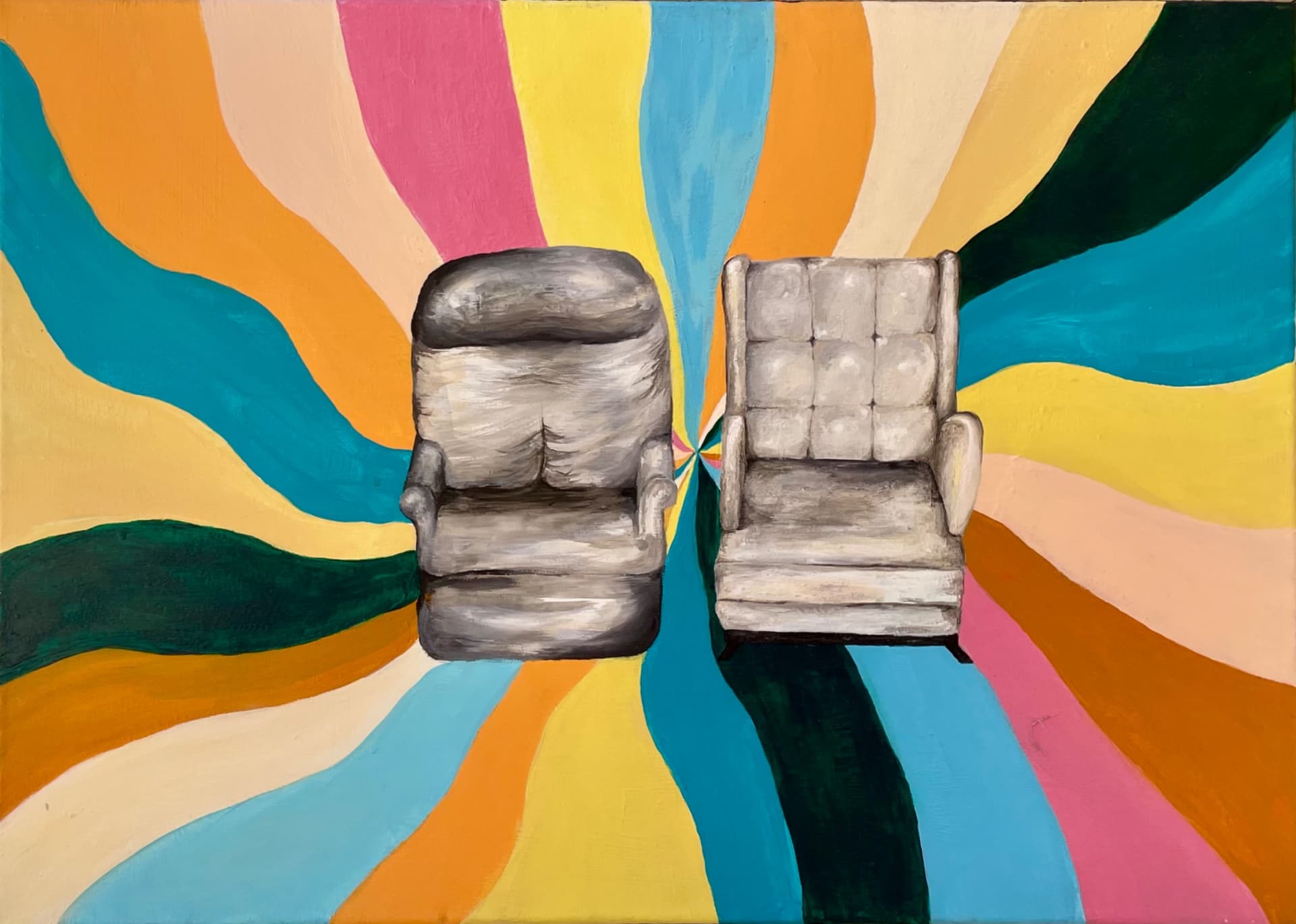
My grandfather used to sit in the right armchair, right next to my grandmother. After they passed away I couldn't bring myself to sit in those same chairs. It felt as though their home was frozen in time, while life all around kept moving forward, taking on a new shape. "Place" used to be a pretty ordinary word in my life—saving a place at a concert, visiting a new place. But then it hit me: a place is actually the space where we hold a connection with the person across from us. It is a space that can feel just as empty as it once was full, even when the physical object remains and the person we loved is gone. In Jewish tradition, "The Place" (HaMakom) is also a synonym for God, for existence itself. The hypnotic background evokes a feeling of being beyond time, a realm where our connection to those we love lives on naturally. It keeps pulsing above these nostalgic objects, which seem to lose their meaning in their owners' absence. But the place, the love, and the honor we held for them—those never fade. Visual Details: The painting features a centered, high-contrast composition. At its heart are two empty vintage armchairs painted in a realistic, monochromatic style, with black, white, and grey tones that emphasize their texture and volume. From the space between the chairs, a dynamic, psychedelic background unfolds in swirling ribbons of color, blending shades of yellow, orange, light blue, pink, and deep green. This sharp contrast between the nostalgic, black-and-white center and the vibrant, mesmerizing background creates a compelling visual tension, drawing the viewer's eye straight into the empty space left in the middle.

Ayelet Hashachar
Ayelet Hashachar’s work grows out of her experiences with people, nature, music and dance, prayer and solitude. Her work moves between femininity and the body, bright colors and delicate drawings, and darker, mysterious images. She is drawn to different worlds that may seem opposite at times, but beneath their differences she feels something they share — a sense of life and a feeling that awaken in her and find their way into her art. Ayelet Hashachar does not try to show reality exactly as it looks, but to express how she experiences it inside herself. Through figures, lines, movement and shapes, she gives these experiences a form that goes beyond their outer appearance. She began making art at a young age; at 13, she held her first solo exhibition in Tel Aviv and studied at the Center for Excellence in Art in Be’er Sheva. For those who look closely at her work, it can become a kind of open book to her inner world.
Ayelet Hashachar’s work grows out of her experiences with people, nature, music and dance, prayer and solitude. Her work moves between femininity and the body, bright colors and delicate drawings, and darker, mysterious images. She is drawn to different worlds that may seem opposite at times, but beneath their differences she feels something they share — a sense of life and a feeling that awaken in her and find their way into her art. Ayelet Hashachar does not try to show reality exactly as it looks, but to express how she experiences it inside herself. Through figures, lines, movement and shapes, she gives these experiences a form that goes beyond their outer appearance. She began making art at a young age; at 13, she held her first solo exhibition in Tel Aviv and studied at the Center for Excellence in Art in Be’er Sheva. For those who look closely at her work, it can become a kind of open book to her inner world.


Similar Artworks